WhatsApp us

Heat Conduction

Experiment Procedure
• Measure how temperature changes with time along metal bars which are heated at one end but remain cool at the other in both dynamic and steady states.
• Measure the flow of heat in the steady state.
• Determine the heat conductivity of the material from which the bar is made.

Summary
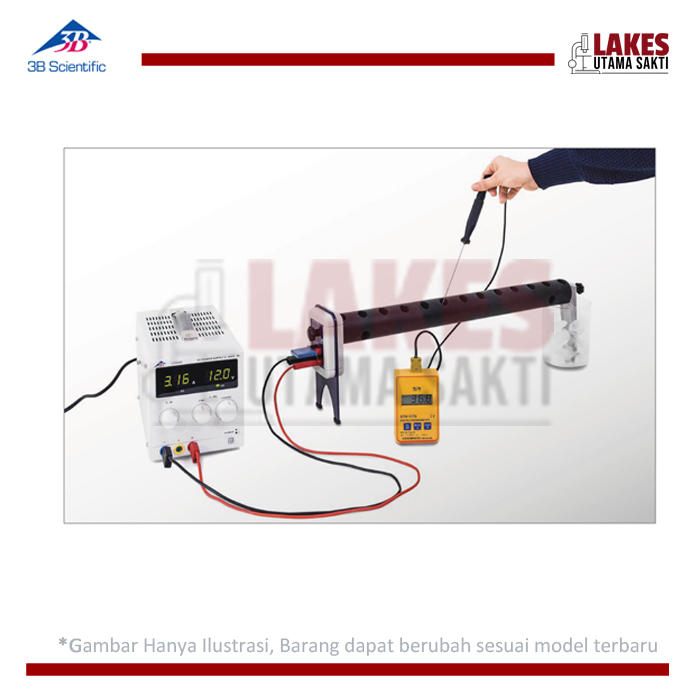
Conduction of heat involves heat being transferred from a hotter part of an object to a colder area by means of the interaction between neighboring atoms or molecules, although the atoms themselves remain in place. In a cylindrical metal bar with ends maintained at different temperatures, a temperature gradient will emerge along the bar after a while. The temperature decreases uniformly from the warm end to the cold end and a constant flow of heat arises through the bar. The way the situation changes from a dynamic state to a steady state is observed by means of repeated measurements to determine the temperatures at various measurement points. The metal bars are electrically heated so that the flow of heat in the steady state can be determined from the electrical power supplied.

Required Apparatus
1 Heat Conduction Equipment Set [1017329]
1 Heat Conducting Rod Al [1017331]
1 Heat Conducting Rod Cu [1017330]
1 DC Power Supply 0 – 20 V, 0 – 5 A (230 V, 50/60 Hz) [1003312]
1 Digital Quick Response Pocket Thermometer [1002803]
1 K-Type NiCr-Ni Immersion Sensor, -65°C – 550°C [1002804]
1 Pair of Safety Experimental Leads, 75cm, red/blue [1017718]
1 Set of 10 Beakers, Low Form [1002872]

klik E-KATALOG

Description

Merk: 3B SCIENTIFIC

Experiment Procedure
• Measure how temperature changes with time along metal bars which are heated at one end but remain cool at the other in both dynamic and steady states.
• Measure the flow of heat in the steady state.
• Determine the heat conductivity of the material from which the bar is made.

Summary
Conduction of heat involves heat being transferred from a hotter part of an object to a colder area by means of the interaction between neighbouring atoms or molecules, although the atoms themselves remain in place. In a cylindrical metal bar with ends maintained at different temperatures, a temperature gradient will emerge along the bar after a while. The temperature decreases uniformly from the warm end to the cold end and a constant flow of heat arises through the bar. The way the situation changes from a dynamic state to a steady state is observed by means of repeated measurements to determine the temperatures at various measurement points. The metal bars are electrically heated so that the flow of heat in the steady state can be determined from the electrical power supplied.

Required Apparatus
1 Heat Conduction Equipment Set [1017329]
1 Heat Conducting Rod Al [1017331]
1 Heat Conducting Rod Cu [1017330]
1 DC Power Supply 0 – 20 V, 0 – 5 A (230 V, 50/60 Hz) [1003312]
1 Digital Quick Response Pocket Thermometer [1002803]
1 K-Type NiCr-Ni Immersion Sensor, -65°C – 550°C [1002804]
1 Pair of Safety Experimental Leads, 75cm, red/blue [1017718]
1 Set of 10 Beakers, Low Form [1002872]